
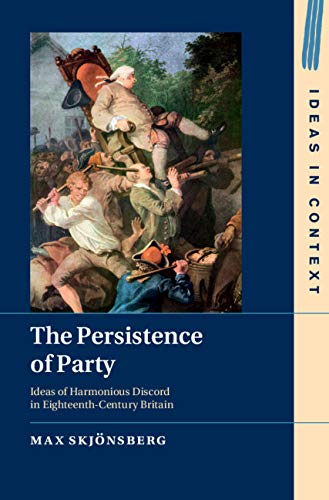
The Persistence of Party: Ideas of Harmonious Discord in Eighteenth-Century Britain (Ideas in Context)
Product details
| Management number | 231971076 | Release Date | 2026/06/18 | List Price | US$10.40 | Model Number | 231971076 | ||
|---|---|---|---|---|---|---|---|---|---|
| Category | |||||||||
Political parties are taken for granted today, but how was the idea of party viewed in the eighteenth century, when core components of modern, representative politics were trialled? From Bolingbroke to Burke, political thinkers regarded party as a fundamental concept of politics, especially in the parliamentary system of Great Britain. The paradox of party was best formulated by David Hume: while parties often threatened the total dissolution of the government, they were also the source of life and vigour in modern politics. In the eighteenth century, party was usually understood as a set of flexible and evolving principles, associated with names and traditions, which categorised and managed political actors, voters, and commentators. Max Skjönsberg thus demonstrates that the idea of party as ideological unity is not purely a nineteenth- or twentieth-century phenomenon but can be traced to the eighteenth century. Read more
| ASIN | B08QCXKS2W |
|---|---|
| XRay | Not Enabled |
| ISBN13 | 978-1108899048 |
| Language | English |
| File size | 4.5 MB |
| Page Flip | Enabled |
| Publisher | Cambridge University Press |
| Word Wise | Enabled |
| Print length | 390 pages |
| Accessibility | Learn more |
| Screen Reader | Supported |
| Part of series | Ideas in Context |
| Publication date | January 28, 2021 |
| Enhanced typesetting | Enabled |
Bestseller ranking
Beverage Tubs


Customers who viewed this product also viewed
Political Parties





Correction of product information
If you notice any omissions or errors in the product information on this page, please use the correction request form below.
Correction Request Form